Table of Contents
There’s a number in NBME’s official score interpretation documentation that most students have never looked up. It’s not buried — it’s in a publicly available PDF on usmle.org. It just doesn’t appear on your score report in a way that would make you stop and think.
That number is the Standard Error of Measurement. For Step 2 CK, USMLE’s own documentation states it’s approximately 6 points.
What that means in practice: if your actual clinical knowledge sits at a true level of 245, your next NBME could legitimately come back as 239 or 251 — with no change in what you know. The exam estimates your ability through a probabilistic process, and NBME tells you the margin of error in a document almost no one reads before panicking at midnight.
Most score-drop conversations skip this entirely and jump straight to “which form is harder” or “should I postpone.” Those questions matter. But they’re downstream of a more basic issue: any single NBME score carries built-in imprecision that makes it a poor basis for major decisions on its own.
The Number on Your Report Is an Estimate
Most students treat their NBME score like a weight on a scale — a fixed number that accurately reflects reality. That framing is wrong, and NBME’s own documentation says so.
Per the official USMLE Score Interpretation Guidelines:
- SEM for Step 2 CK: approximately 6 points. A reported 235 means your actual ability most likely falls somewhere between roughly 229 and 241. This is also why NBME score accuracy discussions that treat practice scores as exact predictions miss the point — the instrument itself has a range built into it.
- SED for Step 2 CK: approximately 8 points. The Standard Error of Difference is the threshold at which a gap between two scores becomes statistically meaningful. A 6-point drop between two forms is, by NBME’s own statistics, within expected measurement noise. It doesn’t require an explanation. It doesn’t mean you got worse.
Nobody tells you this. Then you take Form 30 after Form 28, see a 10-point difference, and spend a week trying to figure out what you forgot.
Sometimes a score drop reflects something real. But a significant portion of swings that send students into crisis mode are just measurement variance.
Why Reddit Score Threads Are Systematically Misleading
Before getting into form comparisons, it’s worth being honest about the data most students use: Reddit threads.
There’s a selection bias baked into every r/step2 score thread. Students who got unexpectedly low scores post. Students who got exactly what they expected mostly don’t. This creates the perception that certain forms are uniquely brutal, or that UWSA1 always overpredicts by 15+ points. Some of these patterns are real — but their magnitude gets inflated by a mechanism that’s invisible to anyone just reading the posts.
What community-aggregated data actually shows is more nuanced. NBME forms do vary in difficulty, and some of that variation is real. But separating true difficulty differences from SEM variance using anecdotal Reddit data is genuinely difficult. Form 28 does tend to produce higher scores than Form 30 — but how much of that is actual difficulty versus measurement noise is hard to isolate.
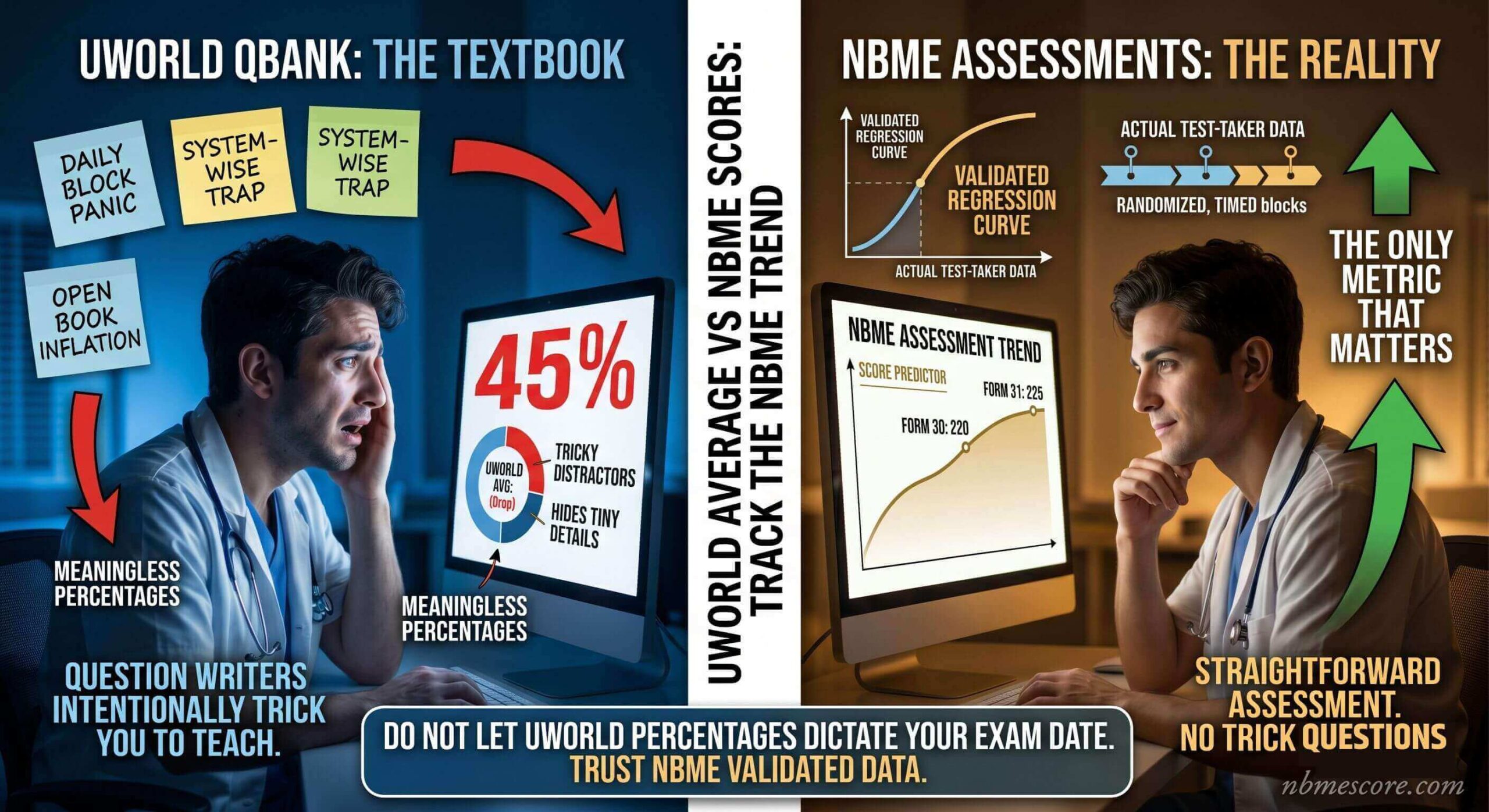
Take form comparisons — including ones on this site — with appropriate skepticism. They’re informed estimates, not controlled data. For a deeper look at how UWorld average scores map to NBME performance, the same caveat applies — those correlations are community-derived, not published validity data.
UWSA1 vs. UWSA2: Two Different Tools
If your score fluctuation involves a large drop after a high UWSA1, this section is for you.
UWSA1 consistently overpredicts Step 2 CK scores — community data across Reddit score spreadsheets puts the typical overprediction at roughly 3–8 points, not the 10–20 that gets repeated in forums. The structural reason: UWSA1 question distribution leans toward diagnostic recall, where strong pattern recognition from a recent QBank pass carries you through. Students who just finished UWorld often look better on UWSA1 than they actually are. For a detailed breakdown of why the two assessments behave differently, see UWSA1 vs UWSA2: Which Is the Better Predictor — that article covers the Step 1 versions, but the structural logic applies to Step 2 CK as well.
UWSA2 is harder, loads more heavily on complex management and clinical reasoning under time pressure, and is a closer approximation of what the actual exam tests. Community data consistently places UWSA2 as a better predictor than UWSA1, with a smaller overprediction bias — typically in the 0–5 point range.
The practical hierarchy for prediction: NBME ≈ UWSA2 >> UWSA1.
Use UWSA1 as a mid-preparation diagnostic, taken 3–5 weeks out. Use UWSA2 as your final readiness estimate, taken 7–10 days before your exam. Don’t make a go/no-go scheduling decision based on UWSA1 alone.
The 218 Passing Standard: What Changed
Effective July 1, 2025, the USMLE Management Committee raised the Step 2 CK passing standard from 214 to 218 following a formal review process involving independent physician panels and surveys of residency program directors.
Any Reddit thread, forum post, or score comparison document predating this change is operating on an outdated threshold. The NBME Step 2 CK score conversion guide on this site has been updated to reflect the new standard — if you’re using any tool or calculator that still shows 214, stop using it.
If you’re testing in 2025 or 2026 and calibrating off 2022–2023 threads, you’re using the wrong reference point. A 216 that passed two years ago no longer passes. The pass rate remains high — approximately 98% of first-time US/Canadian test-takers pass Step 2 CK — but for students who were hovering in the 210–218 range under the old standard, this shift is not abstract. And for everyone else: your buffer above passing has effectively shrunk by 4 points.
When a Score Drop Is Signal vs. Noise
Not every score drop deserves to be explained away. Some are genuine signals.
Noise — things that should not change your plan:
- An isolated drop on a form with documented difficulty differences (Form 28 → Form 30 especially)
- A drop following clear sleep deprivation or significant test-day execution issues
- A drop within the SEM range (~6 points) of your rolling average
- A single UWSA1 that looks significantly better than your NBMEs
Signal — things that warrant honest reassessment:
- Two or three consecutive forms trending downward on comparable forms, with no external execution variable
- The same systems appearing weak across every form you take, with no improvement over weeks
- A low score specifically on Form 28, which has a reputation as the most forgiving current form — a 210 on Form 28 is a different conversation from a 210 on Form 30
- Practice scores consistently below 218 with your exam date approaching
If consecutive drops have you genuinely questioning your exam date, the data-based framework for deciding whether to delay your USMLE is worth reading before making any scheduling calls.
One diagnostic that rarely gets mentioned: take a timed block under real conditions 48 hours after a bad form. Not tutor mode, not subjects you’re comfortable with — real conditions. If performance bounces back meaningfully, the original drop was almost certainly form difficulty plus an execution issue. If it doesn’t bounce, that’s content. Address it directly.
What to Do in the 48 Hours After a Bad Score
The most common mistake after a bad NBME is opening First Aid or Pathoma and reading. It feels like studying. It provides the sensation of doing something. It is almost always the wrong move.
What actually produces useful information:
First 12 hours: Nothing. Specifically, no scheduling decisions. Your capacity for accurate risk assessment is impaired right now. Sleep first.
Next 24 hours: Go through your wrong answers and categorize each one specifically. One sentence per question: What single piece of information would have made me get this right? “I got renal wrong” is not actionable. “I didn’t know that eosinophiluria plus recent antibiotic exposure points to acute interstitial nephritis” is actionable.
At 48 hours: One timed block under real conditions. Use the result as diagnostic data — did you bounce back, or is the same pattern repeating?
If the same weak areas appear across multiple forms, that’s a content gap. If your wrong answers are dominated by changed answers, misread stems, and rushed last-block decisions — that’s not a content problem. That’s test execution, and more reading won’t fix it. On exam day specifically, having a solid Prometric break strategy in place eliminates one variable that shouldn’t be costing you points.
The Formula That’s More Useful Than Any Single Score
The most defensible approach: average your last two NBME or UWSA2 scores, weight slightly toward the more recent one, and treat that as your expected range with a ±5–7 point window.
Community data from students who reported both practice scores and actual Step 2 CK outcomes shows the same pattern consistently: real scores tend to land near the average of the last two quality assessments — not at the highest, not at the lowest. The student who scores 238 then 224 is probably a 229–233 student.
This is also why the UWorld second pass question comes up so often in this context — students chasing a higher number sometimes assume doing UWorld incorrects again will move their NBME. Sometimes it does. But if the gap between your QBank performance and your NBME is structural, more questions won’t close it.
Single scores are measurements. Multiple scores are a trend. Trends are much harder to fool.
FAQ: NBME Score Fluctuating
Que. Score dropped 15 points. Is that actually a lot?
Ans. By NBME’s own numbers, the SED for Step 2 CK — the threshold at which a difference becomes statistically meaningful — is approximately 8 points. So a 15-point drop is outside the noise range and does warrant attention. But before treating it as evidence of genuine regression: were the two forms comparable? A Form 28 → Form 30 swing is not apples-to-apples. Were you sleep-deprived, sick, or testing in a bad environment? Did you take a timed block 48 hours later? If performance bounces, it was likely form difficulty and execution. If the same subjects keep bleeding — that’s content.
Que. UWSA1 showed 258. NBME came back 241. What do I believe?
Ans. Believe something closer to the NBME. The 17-point gap is larger than UWSA1’s typical overprediction range of 3–8 points, which means the NBME is catching something real. UWSA1 rewards fresh QBank pattern recognition in a way NBMEs don’t — students who just finished UWorld often look inflated on UWSA1. Take UWSA2 seven to ten days out and use that as your final calibration. The two scores together will tell you more than either alone.
Que. Does the 218 change matter if I’m already scoring well above it?
Ans. For high scorers, not directly. But if you’re using pre-2025 Reddit threads to benchmark “safe zone” ranges, those threads were written under the 214 standard. The change matters most for students in the 210–225 range. If you’re consistently in the 240s+, the passing standard itself isn’t your concern.
Que. Same systems keep showing up as wrong on every form. Should I be worried?
Ans. That’s not score fluctuation noise — that’s a content gap telling you exactly where to spend time. Note which systems, identify what specifically you’re missing within them, and address those directly. Recurring system-specific misses almost never resolve on their own. If ethics and quality improvement questions are consistently bleeding, this breakdown of Step 2 CK QI and patient safety questions is worth a read — it’s a category most students underprepare for.
Que. Exam is in two weeks and I’m scared to take another NBME. Should I just skip it?
Ans. Don’t skip it. If you don’t test, you keep your current sense of where you stand — which may be wrong in either direction. Take it, sit with the number, and use the 48-hour protocol above. If it comes back low, you need to know that now. If it comes back fine, you have two weeks of actual confidence instead of two weeks of hoping.
The Bottom Line
A single NBME score is a measurement taken with an instrument that USMLE itself acknowledges carries approximately 6 points of inherent imprecision. It is not a verdict on your readiness.
If your scores are fluctuating, stop treating each one as a final judgment and start treating the series as the data it is. Average the last two. Note the trend direction. Check whether the same systems keep appearing in your wrong answers. And when the bad score hits — because it probably will at some point during dedicated — remember that one bad Sunday night is one measurement.
Take more measurements, then decide.