Table of Contents
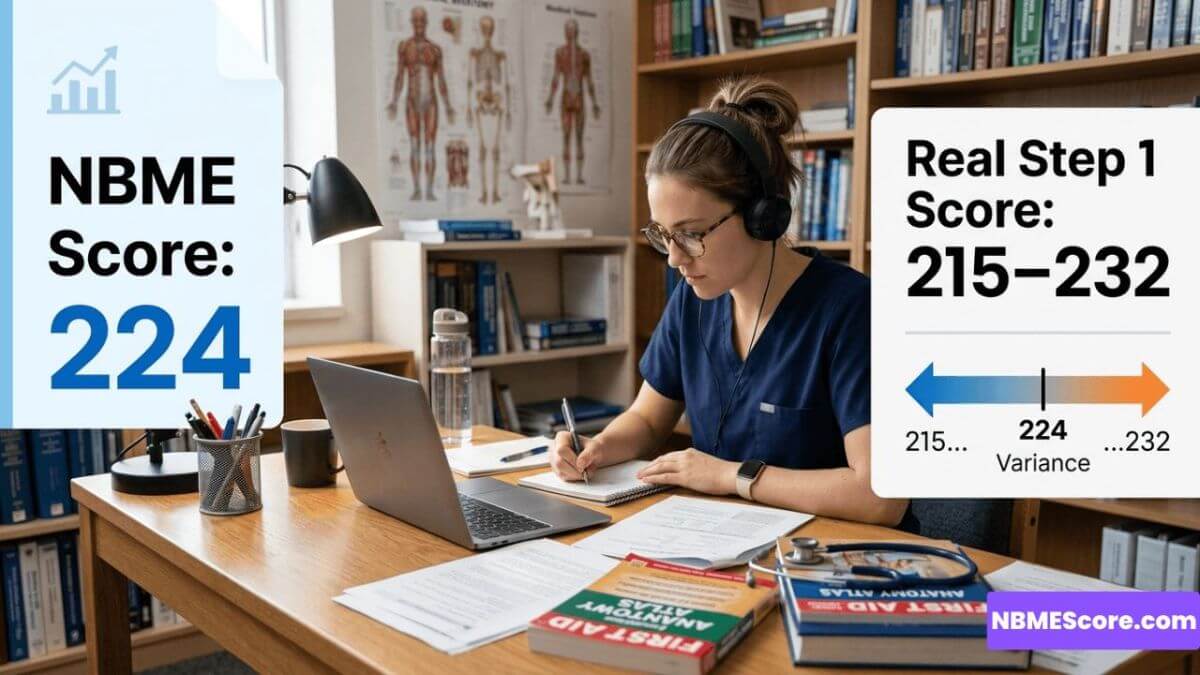
You just finished NBME 28 and scored 224. Now comes the real question: Is this your actual Step 1 score — or just an illusion?
NBME score accuracy is one of the most debated topics among medical students preparing for USMLE Step 1. Some students rely on it heavily, while others feel their real exam score was very different.
So what’s the truth in 2026? This guide breaks down exactly how accurate each NBME form is, what the research says, and what your score actually means for exam day.
What NBME Self-Assessments Actually Measure
NBME score accuracy starts with understanding what these exams are designed to do. NBME Comprehensive Basic Science Self-Assessments (CBSSA) — commonly called NBME forms — are written by the same organization that writes the actual USMLE Step 1. They use the same content blueprint, similar question styles, and a scoring algorithm designed to estimate your three-digit score.
But here’s the key word: estimate.
NBME self-assessments are not the real exam. They’re shorter, taken under different conditions, and use a conversion formula that maps raw performance to a predicted three-digit score. That formula is different for every form — and the difficulty of each form varies significantly.
This is why two students with the same UWorld percentage can score very differently on NBME 28 vs NBME 30.
The Research on NBME Score Accuracy
Studies looking at NBME score accuracy consistently find a correlation coefficient (R²) of approximately 0.70–0.85 between NBME practice scores and actual Step 1 performance. What this means practically:
- The correlation is strong but not perfect
- A 10-point variance in either direction is common
- Students performing in the middle range (205–225) see the most variability
- Students scoring very high (235+) or very low (below 200) tend to land closer to their predicted range
A 2019 study published in Medical Education found that NBME self-assessments taken within four weeks of the real exam predicted Step 1 scores with a mean absolute error of approximately 7–9 points. Translation: your NBME score accuracy puts you within 7–9 points of your actual result, in either direction.
How Each NBME Form Compares in Difficulty (2026)
NBME score accuracy varies significantly across forms because each uses a different scoring formula and difficulty level. Here’s a complete comparison:
| Form | Difficulty | Pts/Wrong | Passing | Overpredicts? | Best Used |
|---|---|---|---|---|---|
| NBME 25 | Easy | ~1.05 pts | ~73 wrong | Yes, 3–5 pts | Wks 2–3 baseline |
| NBME 26 | Moderate | ~1.11 pts | ~72 wrong | Slightly | Wks 4–5 checkpoint |
| NBME 27 | Moderate | ~1.11 pts | ~71 wrong | Slightly | Wks 4–5 checkpoint |
| NBME 28 | ⭐ Easiest | ~1.05 pts | ~75 wrong | Yes, 3–5 pts | Wks 5–6 confidence |
| NBME 29 | Mod-Hard | ~1.09 pts | ~72 wrong | Minimal | Wk 7 final predictor |
| NBME 30 | 🔥 Hardest | ~1.15 pts | ~70 wrong | No — conservative | Wk 7 final predictor |
| NBME 31 | Mod-Hard | ~1.10 pts | ~72 wrong | Minimal | Wk 7 final predictor |
Key takeaway: NBME 28 is the most lenient form — it feels great but overpredicts your real score. NBME 29 and 30 are the most accurate final predictors. Use the table above to pick the right form for your current stage of preparation.
3 Key Factors That Affect NBME Score Accuracy
Factor 1: Timing
The closer your NBME is to exam day, the higher the NBME score accuracy. Community data consistently shows:
- NBME taken 4+ weeks before exam: accuracy within ±10–12 points
- NBME taken 2–3 weeks before: accuracy within ±8–10 points
- NBME taken 1 week before: accuracy within ±5–8 points
An NBME taken in week 2 of dedicated is a baseline measurement — expect meaningful improvement if you study effectively. An NBME taken 7–10 days before your exam is your most accurate predictor.
Factor 2: Test Conditions
Many students take NBME practice exams with breaks, distractions, or access to notes. This directly inflates your score and reduces NBME score accuracy as a predictor. On real exam day, you’re in a testing center for 8 hours under strict conditions.
Take your final 1–2 NBME forms under true exam conditions: timed, no breaks beyond official ones, and no looking anything up between blocks.
Factor 3: Exam Anxiety and Fatigue
Real Step 1 involves 280 questions across 7 blocks in a single day. NBME practice forms are 200 questions. Fatigue and exam anxiety reduce NBME score accuracy by creating conditions in the real exam that practice doesn’t fully replicate — particularly in blocks 5–7.
What Your NBME Score Actually Tells You
230+ on NBME 29 or 30
Strong NBME score accuracy here — you’re well-prepared. Real Step 1 performance will likely land within ±5 points. Focus on consistency, not cramming new material in the final week.
215–229 on a moderate-difficulty form
Solid passing margin. Continue targeted review of weak areas, and take one more assessment (NBME 30 or UWSA2) before scheduling if possible.
200–214
Borderline range. A 210 on NBME 28 (easiest form) is more concerning than a 210 on NBME 30 (hardest form) — because NBME 28 overpredicts by 3–5 points. Identify your weak subjects and give yourself 2–3 more weeks of targeted study if below 210.
Below 200
This is a clear signal to delay regardless of which form you took. Extend your dedicated period before scheduling.
A Realistic Way to Think About NBME Score Accuracy
Think of your NBME score not as a single prediction but as a range. If you scored 220 on NBME 27, your actual Step 1 result will most likely land somewhere between 212 and 228. The question is: where in that range do you want to be?
Factors that push you to the HIGH end of your range:
- Good sleep the night before exam day
- Proper nutrition and hydration
- Taking all official breaks — never skip breaks on the real exam
- Practicing under full 8-hour conditions before exam day
- Low anxiety built through consistent, process-oriented studying
Factors that push you to the LOW end of your range:
- Last-minute cramming that disrupts sleep
- Skipping breaks in early blocks because you feel good
- Test anxiety from feeling underprepared
- Never practicing under full-day conditions
Your Personal NBME Dashboard
Submit your score once — unlock a full dashboard with personalized insights, sent to your email instantly.
The Bottom Line on NBME Score Accuracy
NBME scores are genuinely useful predictors — but no single NBME score is a guarantee. A 224 on NBME 27 means you’re likely in the 215–232 range on real Step 1. The more NBME forms you take under real conditions, the more data points you have to understand your true readiness.
Use multiple forms. Compare your scores across forms. Look at the trend, not just one number. And when in doubt, take one more NBME before you schedule — more data always helps.
Want to calculate your exact predicted score from any NBME form? Use our free NBME score calculators — each one uses a formula verified against real student data.
Frequently Asked Questions About NBME Score Accuracy
Q: How accurate is NBME 28 for predicting real Step 1?
NBME 28 is the least accurate form for predicting real Step 1 because it is the easiest current form. It typically overpredicts your actual score by 3–5 points. A 224 on NBME 28 likely corresponds to a true Step 1 readiness of approximately 219–221. Use NBME 28 as a confidence booster, not as a final readiness indicator.
Q: Which NBME form is most accurate for Step 1 prediction?
NBME 29 and NBME 30 are the most accurate predictors for real Step 1 performance. NBME 30 is the most conservative — it is the hardest current form and rarely overpredicts. If you score well on NBME 30, you’re in genuinely strong shape. NBME 31 is also highly accurate based on early 2025–2026 community data.
Q: Can my NBME score be 10+ points off from my real Step 1?
Yes, it can — and it happens regularly, especially when the NBME was taken more than 3–4 weeks before the real exam, taken under non-exam conditions (breaks, notes, distractions), or from an easier form like NBME 25 or 28. The standard error of measurement for NBME forms is approximately 8–10 points.
Q: Does NBME score accuracy change based on when you take it?
Yes, significantly. An NBME taken 4+ weeks before your exam has an accuracy range of ±10–12 points. The same form taken 1 week before exam has accuracy within ±5–8 points. Always take your final assessment form within 7–10 days of your scheduled Step 1 date for the most useful prediction.
Q: My NBME score went down between two forms. What does that mean?
A declining NBME score across forms is more concerning than any individual score. It can indicate burnout, poor sleep, ineffective study methods, or test anxiety. It does not necessarily mean your content knowledge is getting worse — but it does mean something in your approach needs to change before exam day. Review your study methods, sleep schedule, and practice test conditions.
Q: Is NBME score accuracy different for IMGs vs US medical students?
The scoring formula itself is the same regardless of student background. However, IMGs may experience more variance between NBME practice scores and real Step 1 performance due to differences in clinical exposure, test-taking familiarity, and exam anxiety. For this reason, IMGs are generally advised to target a slightly higher NBME benchmark (215+ on NBME 29/30) before scheduling Step 1.
Q: Should I trust my NBME score or my UWorld percentage more?
Your NBME score is more reliable as a Step 1 predictor than your UWorld percentage. UWorld percentage is influenced by how you use the question bank — students who check answers mid-block or discuss questions before finishing will have inflated percentages. NBME forms, taken under proper conditions, more closely replicate actual exam experience.
Disclaimer: All NBME score predictions are educational estimates. Actual USMLE Step 1 results may vary. NBME® and USMLE® are registered trademarks of their respective organizations. This content is not affiliated with or endorsed by NBME or USMLE.