Table of Contents
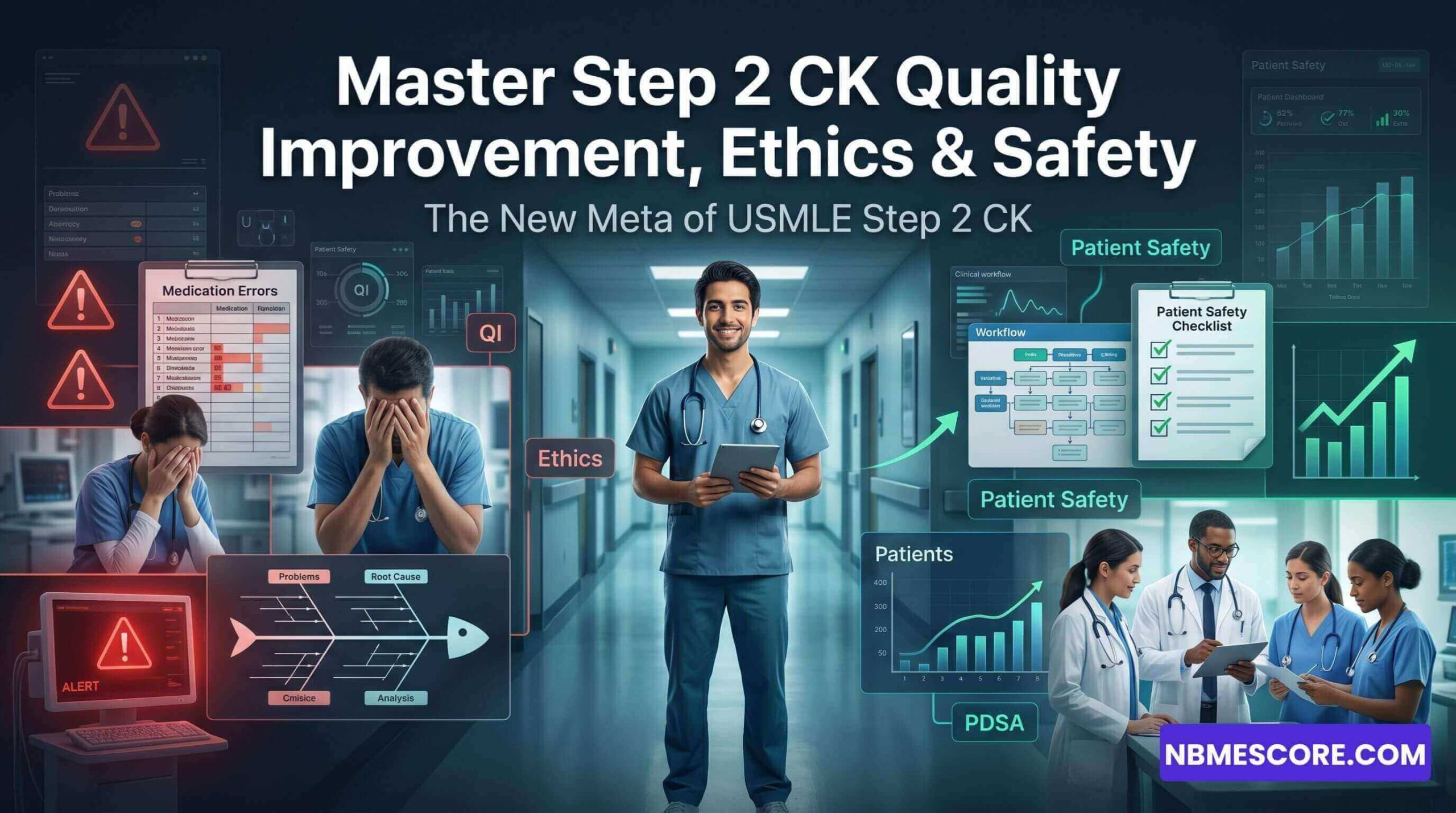
You’re working through a 40-question NBME block. Question 12 describes a hospital where nurses have been making medication errors — two similarly named drugs stored next to each other in the Pyxis. The question asks: what is the most appropriate next step?
You pick “educate nursing staff on proper medication administration.” It feels like the responsible answer. NBME marks it wrong.
The correct answer was “separate the two medications in the Pyxis.” A system-level fix, not an education intervention. The distinction feels obvious in hindsight — but inside a timed block, reading that vignette through the lens of “what should the individual do?” instead of “what should the system do?” happens to prepared students constantly. It is the single most predictable wrong-answer pattern across quality improvement questions on every NBME form.
Students who miss these questions usually know what PDSA stands for. They can define a latent error. They’ve read about root cause analysis. They still miss the majority of QI and ethics questions on their first NBME form — because they’re applying the right definitions with the wrong mental model. Once you understand the three specific failure patterns that drive almost every wrong answer in this category, the questions become straightforward.
The Three Patterns Behind Almost Every Wrong Answer
NBME’s QI questions aren’t testing whether you can define PDSA — they’re testing whether you can recognize a PDSA phase inside a clinical vignette you’ve never seen. These three patterns explain why students who know the content still get these questions wrong.
The Definition Trap — QI Questions
A student knows that PDSA stands for Plan-Do-Study-Act. The vignette describes a hospital reviewing infection rate data after implementing a new catheter bundle. The student matches “reviewing” to Study phase. Correct answer.”
Now the vignette says the hospital “collected baseline data and designed a protocol.” Students who know definitions pick Plan. Students who read carefully notice the hospital also completed a literature review and convened a working group — still in the planning phase, nothing implemented yet. Same phase, different cognitive path to get there.
The fix: Before checking answer choices, write down in one sentence what the hospital is actually doing — not what the question sounds like it’s about. Then match that action to the framework. Keyword matching fails when NBME deliberately uses synonyms.
The Two Defensible Options Trap — Ethics Questions
NBME ethics questions almost always have two answers that are morally defensible by some framework. The wrong answer is usually medically correct — “advise the patient not to drive because their seizure disorder poses a risk to others.” The right answer follows the NBME autonomy hierarchy — “counsel the patient about the risks and strongly recommend they stop driving voluntarily.”
The right answer sometimes feels weaker. It doesn’t involve authorities. It doesn’t immediately protect the public. Students who pick based on moral instinct rather than the NBME decision hierarchy consistently land on the wrong one.
The fix: Learn the hierarchy mechanically before you encounter these questions. When two options both seem defensible, run through the hierarchy — autonomy before beneficence, counsel before disclosure, acknowledge before advise. The answer that preserves patient autonomy one step longer is almost always correct unless there is imminent, identifiable third-party harm.
Individual Fix vs. System Fix — Patient Safety Questions
A medication error occurred. The question asks what the hospital should do next. The answer choices include: educate nursing staff, report the nurse to the medical board, implement barcode medication administration, counsel the pharmacist involved.
NBME almost never wants you to target the individual. Not to educate them, not to report them, not to counsel them — the exception being questions that specifically ask about mandatory reporting of an impaired colleague or professional misconduct, which are individual-level by design. For patient safety vignettes, it wants the system intervention: barcode scanning, separate storage, standardized labeling, pharmacist double-check protocols. Students trained on clinical questions instinctively think about what the physician or nurse should do. QI questions require institutional-level thinking, and switching that mental model mid-block takes deliberate practice.
When a patient safety vignette asks for a “next step,” scan the answer choices and immediately eliminate any option that targets an individual. What’s left will be system-level — and that’s the NBME answer.
How Much of Your Exam Is This Category — And Why the Old Number Is Wrong
The Social Sciences category on Step 2 CK — which includes Legal/Ethical Issues, Professionalism, Systems-based Practice, and Patient Safety — officially constitutes 10–15% of the exam, per the USMLE content outline.
That figure replaced the old 3–7% range after the 2020 blueprint revision. On approximately 240 scored questions, 10–15% is 24–36 scored items in this category. Spread across 8 blocks, you’re looking at 3–5 questions in this category per block — not per exam. Students who encountered pre-2020 prep materials calibrated to the old distribution are systematically underprepared for the current exam.
Three things about this distribution that students consistently underestimate:
They’re spread across every block. There is no “QI block” to mentally prepare for. These questions appear in every block, mixed between cardiology and OB/GYN vignettes. Your brain needs to switch frameworks mid-block with no warm-up.
Ethics questions don’t look like ethics questions. NBME embeds ethical conflicts inside clinical vignettes. The patient has a real medical problem — that part is real and detailed. Then the last sentence introduces an autonomy conflict, a confidentiality issue, or an informed consent question. Students reading for clinical management miss the ethical layer because they’ve already mentally moved on.
The 2020 blueprint expansion was permanent. Every CCSSA form from 11 onward reflects the current distribution. If your prep resources describe this category as “a few questions per exam,” they predate the revision. That framing belongs to a different exam.
The Four Concepts That Cover 90% of QI Questions
This isn’t a glossary — it’s a decision tree for what NBME is actually asking in each question type.
Root Cause Analysis (RCA)
Used after an adverse event has already occurred. The goal is to find the system failure that made the error possible — not to assign blame. NBME signals this with past tense: “a patient received the wrong medication,” “the surgeon operated on the wrong site.”
Failure Mode & Effects Analysis (FMEA)
Used before an error occurs. The goal is to identify potential failure points in a new process. NBME signals this with future intent: “the hospital is opening a new pharmacy wing and wants to prevent errors,” “the unit is implementing a new protocol.”
NBME makes this harder by burying the tense in the clinical narrative. Read the vignette for time orientation before reading the answer choices. “The hospital wants to prevent future errors of this type” → FMEA. “The hospital is reviewing why this error occurred” → RCA. That single distinction separates the two questions entirely.
Individual vs. System
Active vs. Latent Errors
An active error is made by a person at the point of care — the nurse draws up the wrong dose, the pharmacist enters the wrong drug. A latent error is a system vulnerability that made the active error more likely — two similarly named medications stored together, a labeling system that doesn’t distinguish doses clearly. NBME almost always asks for the latent error, because QI frameworks prioritize fixing system conditions over addressing individual actions.
Outcome vs. Near Catch
Sentinel Events vs. Near Misses
A sentinel event is an unexpected death or serious injury unrelated to the patient’s natural illness — requires immediate RCA, never acceptable. A near miss is an error that occurred but didn’t reach the patient — the wrong medication was prepared but caught before administration. Near misses are valuable QI data and should be reported without punishment. NBME consistently tests that near-miss reporting is encouraged, not disciplined.
The PDSA Cycle — Five Question Types NBME Actually Uses
PDSA isn’t just “Plan, Do, Study, Act.” The way NBME tests it varies significantly across forms, and recognizing which question type you’re facing determines the correct answer.
| Question Type | What NBME is Asking | Key Signal in the Vignette |
|---|---|---|
| Identify current phase | What phase is the hospital in right now? | What action is described — designing, implementing, measuring, or deciding? |
| Identify next phase | The hospital just finished X — what comes next? | “They have completed implementation on one unit.” → Next is Study (measure outcomes). |
| Identify a deviation | What did the hospital do wrong in this sequence? | “Implemented hospital-wide immediately” → skipped the Do phase (pilot first). |
| Apply to new scenario | Which phase should they start with, given this situation? | Read what they know and don’t know — what’s missing determines the starting phase. |
| Distinguish from other frameworks | Is this PDSA or RCA/FMEA? | Ongoing improvement cycle → PDSA. Post-error investigation → RCA. Pre-implementation risk → FMEA. |
These question types appear at increasing frequency starting with NBME Form 11 — the first CCSSA form where PDSA cycle questions appear with real regularity.
Ethics Questions Have a Correct Answer — Here Is the Hierarchy NBME Uses
NBME ethics isn’t philosophy. It’s a decision tree with a fixed priority order that, once learned, makes the correct answer mechanical rather than instinctive.
-
1
Patient Autonomy
What does the competent adult patient want? This overrides almost everything else. Even when the patient’s choice is medically suboptimal, a competent adult’s informed decision is respected.
-
2
Beneficence
What is medically best for this patient? This is subordinate to autonomy in most NBME questions — the “medically correct” answer is often the wrong NBME answer when it overrides patient choice.
-
3
Non-maleficence
What avoids harm to this patient? Comes into play when autonomy and beneficence conflict, and when the patient’s choice creates identifiable harm to a third party.
-
4
Justice
What is fair and equitable? Appears in public health, resource allocation, and access-to-care vignettes — especially in newer CCSSA forms.
When two ethical principles conflict in a vignette, autonomy wins against beneficence in almost every NBME question. The exceptions are narrow: the patient is not competent to make decisions, or their decision poses a clear and immediate threat to an identifiable third party. If neither exception applies, the answer that preserves patient autonomy is correct.
Communication questions follow a pattern. The correct NBME answer almost always: acknowledges the patient’s emotion or concern before anything else; asks an open-ended question to gather more information; avoids passing responsibility to another provider (“let me have your attending discuss that with you”); avoids premature reassurance (“I’m sure everything will be fine”); and does not immediately launch into medical explanation without addressing the emotional layer first.
The confidentiality framework. Confidentiality can be broken in three situations: patient consents to disclosure; mandatory reporting applies (child abuse, certain communicable diseases, gunshot wounds — jurisdiction-specific); or an identifiable third party faces imminent and serious harm. NBME tests the third most often. In the classic HIV disclosure vignette, the correct answer sequence is: counsel the patient repeatedly to disclose voluntarily; if they refuse and identifiable third-party harm is clear and imminent, disclosure may be appropriate. Most NBME questions stop before reaching that point — the correct answer is to continue counseling, not to disclose.
Which NBME Forms Test This Most — and How to Use That
Forms 9 and 10: QI and ethics appear at lower frequency and in simpler form. Active vs. latent error identification, basic autonomy questions with an obviously wrong distractor. Missing these usually points to a content gap rather than a framework problem — the frameworks haven’t been stress-tested yet on a real form.
Form 11: The first form where PDSA cycle questions appear with real frequency, and where ethics questions start presenting two genuinely defensible options. Missing these questions is a framework gap, not a knowledge gap. Three hours of focused AMBOSS QI review before Form 11 covers nearly everything this form tests in this category. Students who do that focused review before Form 11 report the clearest improvement in this specific category.
Forms 12 and 13: QI vignettes get longer. The system failure is buried deeper in the clinical narrative rather than stated explicitly. Ethics questions start appearing within public health frames — vaccine counseling, screening access decisions, shared decision-making conflicts embedded in clinical context. Students looking for standalone ethics questions miss them when they’re integrated into clinical vignettes.
Forms 14 and 15: Ethics and communication vignettes appear within systems-level frames — screening access, healthcare equity, shared decision-making alongside active clinical management. The ethical conflict is embedded in a vignette that looks primarily clinical. Students who haven’t practiced identifying embedded ethics questions under timed conditions consistently miss the category shift.
The Resources That Actually Work Here — And What the Data Shows
A 2025 peer-reviewed study by Hubner et al. (n = 275 Step 2 CK students, published in Medical Science Educator) produced one finding that directly applies to QI and ethics preparation: using 3 or more QBanks was significantly associated with lower scores. The mean score of 247.3 in the cohort mirrored national averages, and the data showed no benefit from resource accumulation — only from focused, active engagement with fewer resources.
The most popular resources: UWorld (97.7%), Anki (50.3%), Divine Intervention (50.3%), AMBOSS (49.7%). Total resources used did not impact scores significantly. Using 3+ QBanks was significantly associated with lower scores. Video usage corresponded to lower scores. Podcast and flashcard usage had no significant associations — suggesting the active question-and-answer format of Divine Intervention specifically may explain its effectiveness despite being audio-based.
For QI and ethics specifically, three resources are genuinely worth your time — and the research above suggests you should pick at most two:
AMBOSS Quality & Safety articles are the strongest single resource for this category. Their quality improvement and patient safety articles cover every framework NBME uses — RCA, FMEA, PDSA, active vs. latent error, sentinel events — with attached NBME-style questions. A 5-day free trial or one-month access at the end of dedicated covers everything you need. The article library, not just the QBank, is where the value is here.
Divine Intervention Podcasts — Episodes 230 (Quality Improvement), 234 (Medication Safety and Transitions of Care), and 276 (Professionalism and Ethics) are the three essential ones. Total listen time under four hours. The format is question-and-answer, which matters — passive listening doesn’t build the application framework you need for NBME questions. Follow along actively and answer before the explanation.
UWorld is insufficient on its own for this category. Its QI and ethics question volume is low, and the explanations are thinner than AMBOSS. You’ll exhaust the available questions before building real framework fluency. Use UWorld QI questions as a check after you’ve built the framework elsewhere — not as your primary resource for learning it.
Any resource that frames this category as “2–3 questions per exam, memorize these definitions” is calibrated to the pre-2020 blueprint, when Social Sciences was 3–7% of the exam. The current range is 3–5 questions per block. Resources built on the old numbers leave you underprepared for what the current exam actually distributes.
Knowing which resources to use only matters if you have a clear window to use them.
When to Study This — Specifically
Most articles stop at “don’t ignore QI and ethics” — the when is almost never addressed.
QI and ethics review should not happen in week one of dedicated. These concepts make more sense after you’ve seen how NBME builds clinical vignettes — the same structure they use for clinical questions is also the vehicle for embedded ethics and QI conflicts. Reading the PDSA cycle before you’ve done any NBME practice means memorizing without context. The framework makes sense; you just don’t know yet what it looks like inside an NBME question.
The optimal window is weeks 3–4 of dedicated, after completing UWorld Internal Medicine and Psychiatry blocks. IM and Psychiatry are where communication and ethics overlap most heavily with clinical content — patient decision-making, informed consent, discharge planning, psychiatric holds. Having that clinical foundation makes the ethics decision hierarchy feel like an extension of what you’re already doing, not an arbitrary separate system to memorize.
The total investment: Divine Intervention QI and ethics episodes (under 4 hours) + AMBOSS QI and Patient Safety articles (4–6 hours reading, including attached questions) + 30–40 NBME-style practice questions. Two focused days, not distributed passively across the whole dedicated period. After that, the questions on your CCSSA forms become the practice — you don’t need to keep reading about PDSA cycles.
Track your category-level improvement across NBME forms using the NBME Step 2 CK Score Conversion guide — the subject breakdown shows exactly where you’re gaining and losing points form by form.
FAQ: USMLE Step 2 CK Quality Improvement
Que. How many QI and ethics questions will I actually see?
Ans. Per the official USMLE content outline, Social Sciences — which includes QI, patient safety, ethics, and professionalism — constitutes 10–15% of Step 2 CK. On approximately 240 scored questions, that’s 24–36 scored items in this category, roughly 3–5 per block across 8 blocks. The “it’s only 2–3 questions total” framing you’ll still find on some forums was calibrated to the pre-2020 blueprint, when the range was 3–7%. That number is outdated.
Que. Why do I keep getting ethics questions wrong even when I know the concepts?
Ans. Almost certainly the two-defensible-options trap. NBME ethics questions are constructed so that both the right and wrong answer have ethical justification by some framework. The differentiator is the NBME hierarchy — autonomy before beneficence, counsel before disclosure, acknowledge before advise. If you’re picking based on what feels morally stronger or what you’d actually do, you’ll consistently land on the wrong answer. Learn the decision sequence mechanically, and apply it to every question instead of relying on instinct.
Que. Do I need a full AMBOSS subscription for QI review?
Ans. No. A 5-day free trial at the right point in your prep — or a one-month access pass at the end of dedicated — gives you access to the specific quality improvement, patient safety, and ethics articles you need. The article library is where the value is for this category; you’re not relying on the full QBank. Reading three to four key articles plus the attached NBME-style questions covers the framework comprehensively.
Que. Is the PDSA cycle tested differently on newer forms?
Ans. Yes. On Forms 9–11, PDSA questions tend to ask you to identify a phase given what the hospital is doing. On Forms 13–15, they tend to ask about process errors: “the hospital skipped directly to hospital-wide implementation without a pilot — what did they fail to do?” The harder version requires knowing not just what each phase is, but what purpose it serves and what goes wrong when you bypass it. That distinction matters when you’re reviewing PDSA — understanding the why of each phase, not just the label.
Que. Are communication questions getting harder on recent forms?
Ans. They’re getting more embedded, not necessarily harder. Recent CCSSA forms place communication conflicts inside clinical vignettes rather than presenting them as standalone ethics scenarios. The clinical information is real and relevant — and it’s designed to occupy your attention while the communication question sits in the last two sentences. Students who have practiced identifying embedded ethics questions catch the shift. Students who are reading for clinical management miss it and answer the clinical question instead of the communication question.
Que. What’s the difference between a sentinel event and a near miss on NBME questions?
Ans. A sentinel event is an unexpected death or serious physical injury unrelated to the patient’s natural illness — it’s an outcome, and it requires immediate RCA. A near miss is an error that happened but didn’t reach the patient — the wrong medication was drawn up but caught before administration. The critical thing NBME tests about near misses is that they should be reported and analyzed, not ignored or dismissed because nothing bad happened. Students who think “no harm, no need to report” get these wrong consistently.
QI, ethics, and patient safety is the one category on Step 2 CK where a focused two-day investment reliably produces measurable improvement. Clinical medicine categories take months of spaced exposure to move meaningfully. This category responds to framework learning, and frameworks can be built in a concentrated window.
The students who drop points here aren’t the ones who didn’t study it. They’re the ones who studied the definitions instead of the decision patterns. The framework matters more than the definitions — once you know what NBME is actually asking in each question type, the category stops feeling like a guessing game. Take NBME Form 11 after two focused days on this material and watch the category become the one you’re most confident about in the block.