How We Calculate NBME Scores
This page explains exactly how the score predictions on NBMEScore.com are generated. We believe students deserve to understand the math behind the numbers they are making decisions from — so here it is, without jargon.
Short version: We use linear regression formulas built from real student score reports. Each NBME form gets its own formula because each form has a different scoring curve. The formulas are periodically updated as new data becomes available.
Where the Data Comes From
NBME does not publish official conversion tables. They give you a three-digit score, but they do not tell you the formula they used to calculate it from your raw number of correct answers.
To reverse-engineer that relationship, we collect self-reported data from medical students who share two things: their raw wrong answer count on a specific NBME form, and the three-digit score the NBME portal gave them. These data points are submitted through our calculator — when a student enters their score and provides their email, we log the data point.
We then run linear regression across those data points for each form separately to find the formula that best fits the observed relationship between wrong answers and scaled scores.
Data Quality and Limitations
We are honest about what this data is and is not:
- It is self-reported. Students manually enter their wrong answer count. Errors in data entry exist and we cannot fully eliminate them.
- Sample sizes vary by form. Older forms like NBME 25 and 27 have more data points than newer forms like NBME 31. Newer form formulas carry more uncertainty and will be updated as more data accumulates.
- We cross-reference with community data. Score reports shared on r/step1, r/step2, USMLE forums, and SDN help us validate our formulas against independently reported numbers. When community data conflicts with our regression, we investigate before updating.
- These are estimates, not official scores. The NBME uses psychometric equating methods that we cannot fully replicate. Our formulas approximate the relationship — they do not reproduce it exactly.
The Formula Structure
Every NBME form formula follows the same structure:
The Intercept represents the theoretical maximum score if you got every question correct. The Penalty Coefficient is how many scaled points you lose per wrong answer. Both values are specific to each form.
Current Formula Values by Form
| NBME Form | Intercept | Penalty Per Wrong Answer | Difficulty Level |
|---|---|---|---|
| NBME 25 | 277.04 | 1.113 | Moderate-Hard |
| NBME 26 | 277.22 | 1.138 | Moderate |
| NBME 27 | 275.17 | 1.113 | Moderate |
| NBME 28 | 274.14 | 1.046 | Most Forgiving |
| NBME 29 | 272.18 | 1.090 | Moderate |
| NBME 30 | 278.60 | 1.150 | Hardest |
| NBME 31 | 270.48 | 1.080 | Moderate |
The penalty coefficient is the single most important number in the table. It explains why the same number of wrong answers produces different three-digit scores on different forms. A student who misses 50 questions on Form 28 (penalty 1.046) scores approximately 7 points higher than a student who misses 50 questions on Form 30 (penalty 1.150) — with identical knowledge.
Why Scores Vary Between Forms
Students are often confused when their score drops between forms even though they have been studying consistently. The penalty coefficient difference between forms explains most of that variance.
A 10-point swing between Form 28 and Form 30 on the same number of wrong answers is mathematically expected. It is not a sign of knowledge regression. This is one of the most important things our calculator helps students understand — a single score without context of which form it came from is nearly meaningless.
Pass Probability Calculation
The pass probability displayed in our calculator uses a logistic function centered on the Step 1 passing threshold of 196:
This is a standard logistic curve that assigns near-certain pass probability to scores well above 196, and near-certain fail probability to scores well below it, with uncertainty concentrated around the passing line. The coefficient 0.18 was calibrated to produce probability estimates that match community-reported pass/fail outcomes around the 196 threshold.
Pass probability is a statistical estimate, not a guarantee. Students near the passing threshold should use it as one signal among many, not as a definitive readiness verdict.
How We Update Formulas
Formula updates happen when:
- A new NBME form is released and we accumulate enough data points to build a reliable regression
- Existing community data consistently conflicts with our current formula predictions
- Students report systematic over- or underprediction on a specific form
We do not update formulas based on a small number of outlier reports. Single data points can reflect errors in self-reporting. We look for consistent patterns across multiple independent sources before revising a formula.
Important: Formula accuracy is higher for forms with more community data (NBME 25–29) than for recently released forms (NBME 30–31). If you are using a newer form’s calculator, treat the prediction as a reasonable estimate rather than a precise number. We update these formulas as more data becomes available.
What We Do Not Claim
We want to be direct about the limits of these predictions:
- We do not claim to have access to NBME’s proprietary scoring algorithm. Our formulas are approximations built from student-reported data.
- We do not claim our predictions are more accurate than the NBME’s own score. They are educational estimates.
- We do not claim a specific R² value or correlation coefficient publicly — our data collection is ongoing and those numbers change as new data comes in.
- We are not affiliated with, endorsed by, or sponsored by the NBME or USMLE program. NBME® and USMLE® are registered trademarks of their respective organizations.
Using These Predictions Responsibly
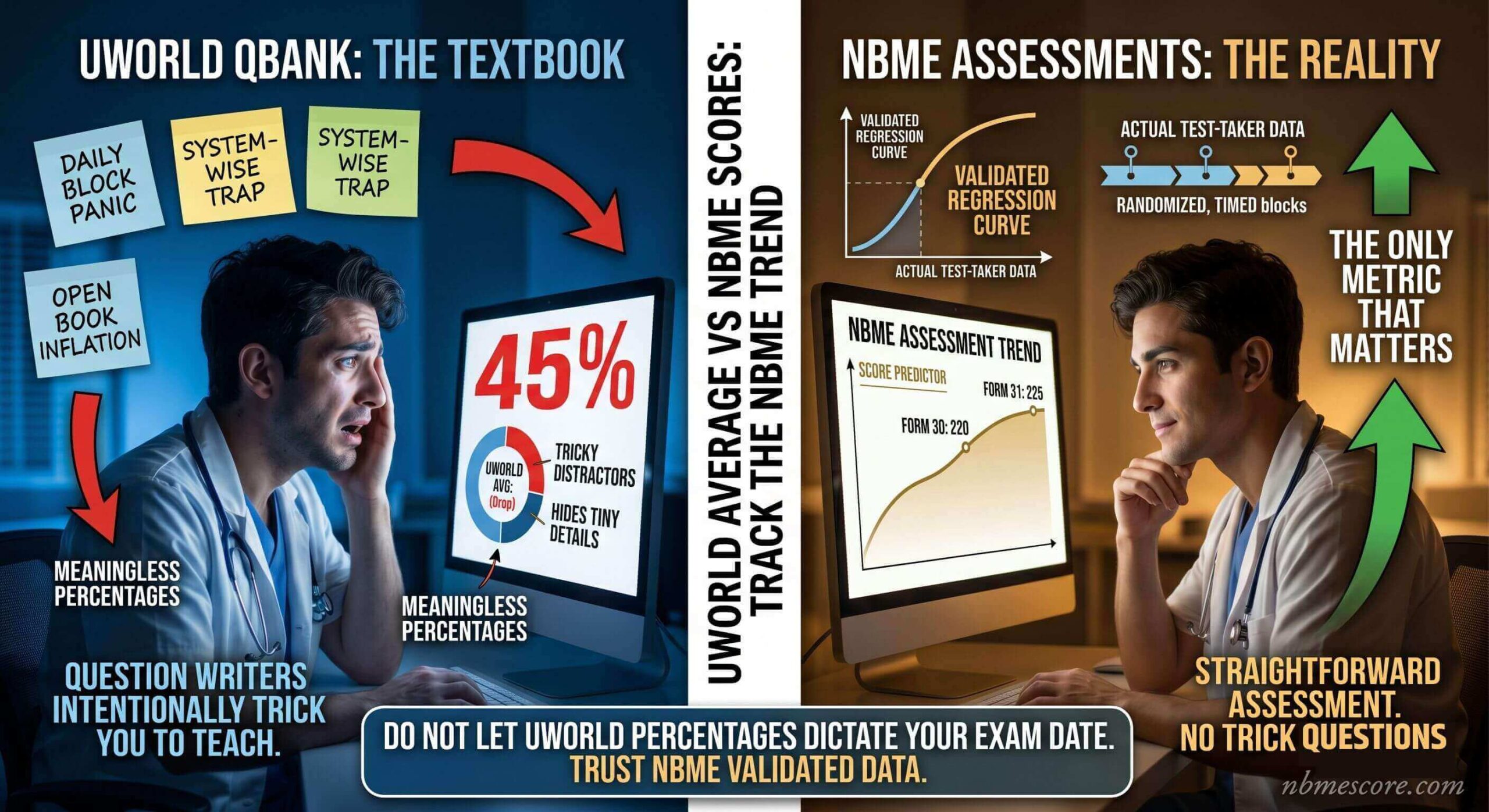
The most useful way to use our calculator is not to obsess over a single score, but to track multiple scores across multiple forms over time. A single data point tells you where you landed on one form on one day. Five data points across different forms tell you where your preparation actually stands.
Our free dashboard is designed specifically for this — it shows your score trend across all forms you have used, adjusted for each form’s difficulty level, so you can see your actual trajectory rather than reacting to individual data points out of context.